Search

Girl From Goat Pasture Road

Musings of Susan Swicegood Boswell

$100 Dollar Hairspray

big-sexy-hair

Recent unanticipated expenditures in the Boswell household including the purchase of a new car have caused my husband and I to take a closer look at our monthly budget. We’ve cut back on eating out and begun shopping the discount bread store. I’ve value-engineered our cable and cell phone packages including a (rather ingenious) intervention on my part which involves simply cutting off my son’s data and texting privileges when he somehow exceeds the “unlimited” plan I spend too much money on anyway.

One of the areas I am most reluctant to cut is the one marked  “Health and Beauty”. A recent review of my monthly expenditures confirm the “natural” look I have boasted for so many years is costing me an unnatural amount of cash. Hair color, styling products and make-up are expensive!

Having grown up in the shadows of  Farrah Fawcett, Cindy Lauper, and the Breakfast Club, I have never relinquished my love for big hair. As a Southern woman of a “certain age” I have lived years under the honor code of “the higher the hair, the closer to God”. It’s an expression nearly every woman in the South between the ages of 50 and 60 not only believes but  lives. Therefore when I recently ran out of my favorite salon style hairspray, I was thrilled to find a huge $9.99 can of something called “Big Sexy Hair” at my local TJ Maxx. With visions of St. Peter and ’80’s angelic icons dancing in my head, I knew this was the right hairspray for me! While I was at it, I also splurged for the $6.98 “Sexy Light” shampoo, which promised manageability and control, without weighing me down, attributes that would surely help my hair, if not my social life.

The next morning as I got dressed for work, my hair was initially light, manageable and gloriously big! I congratulated myself on my purchases and began to spray “Big Sexy” on my newly styled “do”. The first spray from the aerosol can sputtered out in a glob. Giving it a good shake, the second attempt came out in a fierce narrow stream.  Undaunted, I closed my eyes tightly and began to spray, my arm doing a series of rapid and elaborate figure eight’s as I tried to dispel the stream into a spray. I opened my eyes to find disaster!

I had been “flocked”!

Dear God, I looked like a cheap Big Lots Christmas tree, my uppermost branches adorned with heavy mounds of fake snow. I slipped on my reading glasses and squinted at the fine print. “Big Sexy” was not hairspray at all, but some sort of styling mousse. I tried to brush the snow from my hair but it was useless. My “Big Sexy” hair had taken a definite turn for the worse!

Later in the day, as I was recanting my “disast-hair”, one of my friend’s who I can always count on for sound advice suggested I visit Sally’s Beauty Supply where I could purchase professional products at a discounted price. After perusing their shelves over my lunch hour, I determined their hairspray was such a bargain, I would purchase 2 cans. The sales clerk at the checkout told me that for an additional $15.00, I could save 10% on all purchases for the next year. Since I use a lot of hairspray, this seemed a no- brainer.

The next few days did not go so well. The rain and humidity that saturated Greensboro over the next few days were not my fine hair’s best friend. The hair that held such heavenly promise had taken a harrowing turn, if not towards hell, certainly the flatlands.

“What happened to you?”, asked another friend noting my sagging locks. Realizing that my newest “bargain” hairspray offered no resistance to humidity, I conceded my latest purchase was no bargain at all!

By Sunday, I didn’t care what it cost. Desperately tired of looking like an abandoned pound pup, I was willing to pay anything. I drove thirty minutes to the mall to purchase my original hairspray from the expensive salon. Perusing the shelves, I was suddenly confused. My old trusty brand now came in two selections, both offering maximum control. I asked the young sales clerk to explain the difference.

She peered out at me dramatically from dark, side-swept bangs. “Uh, this one says “Platinum”” the eye said while the mouth smacked loudly on a wad of gum.

“Yes, I can read that”, I said testily, “but is one of these better for humidity?”

“Ummm, I guess I need to familiarize myself with this product”, the eye confessed. “I don’t really use hairspray.”

Obviously…

I roll my eyes , a gesture the clerk fails to notice. This person cannot help me.

At this point, only God and Farrah Fawcett can help me. “Give me one of each,” I say, handing the eye the last of my $100 bill.

“And a bottle of Elmer’s Glue, while you are at it!”

Yellow Taxi

cornfield2

As a gift to me for my sixteenth birthday, my parents bequeathed me their old 1968 Ford Fairlane 500. My friends immediately dubbed it “The Yellow Banana”. It was built like a tank, four doors, of course and completely uncool, but it got me where I needed to go. One summer afternoon, I was driving The Banana down the country roads of Davidson County to my part-time job in downtown (or as it is more recently known “uptown”) Lexington. There on a long and desolate stretch of two lane road , my car began to choke and spasm. It occurred to me that I had failed to notice the gas gauge registering near empty. As we came to an undignified stop, I pondered my predicament.  I looked around me  Although I was in central North Carolina, the landscape which rolled before me seemed more like the endless sea of cornfields and pasturelands that you might see in Nebraska or Kansas. Undeterred, I set out in the direction from where I had come.

I had not walked far, when from out of nowhere came a bright yellow taxi.

For those of us who live in the city, there is absolutely nothing unusual about a passing taxi cab, but in 1978 rural North Carolina, at the edge of a cornfield in the middle of nowhere, it was a strange sight, indeed. In fact, having never traveled to a big city, I had never even ridden in a taxi before. Somehow, perhaps from watching too many television sitcoms, I knew what to do. I held up my arm to catch the driver’s attention…

As an adult, I now realize that if you are a cute little 16 year old girl, standing in the middle of nowhere, all dressed up in a breezy summer skirt and Candies, the “hailing” part was completely unnecessary.

The taxi came to an abrupt stop. The driver was dark-skinned, not of any particular nationality I could recognize. I quickly explained my predicament and  he was kind enough to drive me back the few miles to a service station where I called my daddy to bring the gas can. I thanked the cab driver profusely, but he wouldn’t take any money.

Despite the vast numbers of memories I have forgotten over the course of my lifetime- people and years of my life on end- I can recall that day like it was yesterday. The feel of my skirt blowing along my bare legs; the July heat rising up off the pavement; the endless sea of corn blurring a smudge into the horizon; the black and dusty interior of the taxi cab; the dark hairs rising stubby and crisscrossed on the back of the neck of the mysterious driver. This memory reminds me of the many times in my life that have I been the recipient of so much undeserved grace, that I feel almost ashamed.

And yet for reasons we cannot understand, there are other times in our lives when we go through long periods of equally undeserved hardship and struggle. Every day, I hear about good people who suffer multiple and simultaneous difficulties. Perhaps they have lost their job, are facing bankruptcy or the loss of their home or their family or are coping with illness or addiction.  It seems so unfair. It  IS unfair.

The Old Testament story of Job tells of an honorable, exemplary man who faced insurmountable and catastrophic loss. Job lost almost everything: his children, his home, his wealth and his health. It is a powerful story, yet one I have never particularly liked. It makes me feel so small and unable to influence even the smallest aspect of my own destiny.How often it is that our lives feel out of control. We are like the specks of dust being blown around at the mercy of a great wind.

Yet, I also believe, mainly because I have witnessed this in my own life, that there are times in our lives when we are the beneficiaries of a comprehensively undeserved grace. Times when for reasons unknown to us, a Higher Power goes before us, spreading the cornfields like He parted the Sea, and calls forth a yellow taxi, just when we need a ride.


Hitting the Mark

bullseye 3

A few summers back, my sister and I ventured to the eastern part of the state where our brother had taken up residence in an old and crumbling Southern mansion in an equally old and crumbling Southern town. Our brother Tony seemed oblivious to the home’s flaking paint and rotten floorboards. Cobwebs hung in place of draperies from lifeless windows. So much plaster and lathe were missing from some sections of the home’s interior walls, we could simply walk through them instead of using a door. I marveled as I wandered from room to room, if the home was mid- construction or mid-demolition. My brother had recently fallen into “bad times”, the result of a bitter divorce, financial woes, run-ins with the law, alliances with various unsavory  and unscrupulous characters, the culmination of years of alcohol and substance abuse, latent PTSD and some undiagnosed form of mental illness which manifested itself as a predisposition for shooting guns within his homes rapidly diminishing number of upright walls.

Of all the places he could have taken up residence, I couldn’t help but think how he’s landed in this God- forsaken place with the same random outcome one might experience when throwing a dart. If he had been aiming for the bull’s eye, he had certainly hit the outer rim. One day, he was driving through this old town, plunked down some of the money from his Home Equity Line and bought himself a house. A House, in his mind, a fine old house with a capital “H”, in a place far away enough that he knew no one and more  importantly where no one knew him.

Still, my brother loved his ruins with the same affection a king might regard his palace. Like a king surveying his kingdom, he put his portable hot tub smack dab in the middle of the homes formerly grand wrap – around front porch. From this vantage point, he could observe the comings but mostly the goings of the town’s Main Street. Unfortunately, the sheriff asked him a few weeks later to please not sit out there naked with the lights on.

It was in this same grandiose spirit that on that hot August afternoon when my sister and I arrived to help him settle in, he brought out an old tarnished candelabra, elaborately placing it square in the middle of the dining room table. He beckoned me, his baby sister, to “run to the kitchen” where he had left a bouquet of summer flowers wilting in the heat on the Formica countertop. No artwork adorned the tops of the old quartersawn oak wainscoting nor chandelier glistened across the room’s plaster relief ceiling. Instead, tiny dust particles floating heavenward as the sunlight tried to stream in through the window panes now covered with a dense layer of weather-resistant plastic.

My brother had cooked “dinner” as a true backwood’s Southerner calls the noon day meal; “supper” is the name reserved for the meal of the evening. I could never get over the fact that my brother, my big ole redneck, tractor-driving, hunting and fishing and cussing kind of brother had taken to watching cooking shows in his spare time. In recent years, before he had flown the proverbial coop, we’d actually had conversations over the Christmas Dinner table about reduction cooking and parboiling and all kind of things more akin to Chef Gordon Ramsey than a Chevy kind of man. On this day, however, he had brushed most of his newly acquired cooking skills aside, settling on a traditional working class menu of roast beef, boiled potatoes, canned biscuits and pinto beans cooked with fatback.

After dinner, my sister and I took to the kitchen for what his generation still deems “woman’s work“- the clean up as our brother stepped out for a smoke. As my ever efficient sister began to wash dishes, I began gathering up the array of pans and dishes strewn across the countertop. My brother had used a decade’s old  cast iron frying pan to brown the roast and the bottom was thick with grease. “What you want me to do with the grease in the fryin’ pan?”, I called out to him. “Oh, just set it down on the floor,” he called through the screen door. “The dog’ll eat it.”

My sister, who is I might add, a bonified Junior Leaguer (a proud accomplishment if there ever was one in my redneck family) eyed the pan dubiously as I sat it on the floor of the dilapidated linoleum. My brother’s big old hound lumbered into the middle of the kitchen and began to lap up the grease. “Ick” I muttered under my breath as I continued to gather up dishes and carry them across the room for my sister to wash. The dog finally raised his head and with a lick of his chops began to turn away from the pan. As I reached down to pick up the handle, the dog quickly raised his hind leg and began to pee into the pan.

“Oh! My! Gawd!” I gasped.Behind the black dog whose awkward stance seemed to indicate it was making a left hand hand turn, my sister’s mouth and eyes were frozen into big “O”’s. That dog continued to pee such a long steady stream of piss that I swear I saw it steam up like rain on a hot summer street.

“Oh- my- Gawd- that- dawg- just- peed- in- that-frickin’- fryin’-pan!” I hollered, jumping up and down in disbelief.

“To-neeeeeeeey!!!”, I hollered “Get in here!” Menopause had left me bossy and emboldened in my later years.

My brother finally stuck his head in the back door to see what was all the commotion. In one sweep his eyes took in the dog, the steamy frying pan and his two hysterical sisters- one in shock and one shrieking. For the first time in recent months, he seemed to put two and two together and actually get four.

There has not been many times in my life I could properly use the word “guffaw”, but that’s exactly what he did. My brother uttered a guffaw for a moment then disappeared back outside to continue his smoke.

“Oh my Gawd! That DAWG, he just peed in that fryin’ pan!” I hollered again. “To-neeeey! Get in here and take that pan OUTSIDE right now!” I ordered. I could hear my brother continue to snigger sheepishly outside the door. I looked around the floor; there was not a single drop of dog pee on the floor. It was obviously not the first time that dog had peed in the pan. With the utmost precision, it seemed both my brother and his dog had hit the mark!

Churchland Baptist

Churchland Baptist Church

From the polished oak pews of Churchland Baptist Church, I slump against the side of my mother, scribbling cartoon drawings on the back of the church bulletin. Despite my low vantage point, on any given Sunday there is much to inspire me. Sunlight filters through stained glass as fragments of light flutter around the sanctuary. Jesus as a baby. Jesus holding a little lamb. Jesus suspended from a wooden cross.

In front of me, the choir sits behind the pulpit on an elevated platform. When it is time for a hymn, everyone stands at attention while the choir director Russ Griggs moves his outstretched arms in rhythmn. In matching satin robes, the choir looks like rows of yellow goldfinches perched along the top of a fence. Russ flaps his wings preparing to fly while the others stand and chirp like obedient nestlings.

In between songs, the choir just sits there looking bored as if they aren’t really listening to Preacher Martin at all. I know how they feel; I dont like listening to him either. Every Sunday, he starts his talk all nice, like he wants to be your friend. He usually begins by telling a funny story that has supposedly happened to him during the week, but I really don’t think it’s true. By the end of his talk, he has become all worked up. He is wiping his brow with his sleeve and his face is red.I  am not sure what it is , but I am certain we have all done something terribly wrong.

I don’t think Preacher Martin likes me very much anyway. When I ask mama and daddy questions they didn’t know the answers to, like what happened to those poor little babies that didn’t get saved before they died or about the starving children in Africa, my parents invited him to the house for supper so I could ask him directly.  Although Preacher Martin sounded like he knew what he was talking about, his answers didn’t make any sense. His God seemed to have a lot of rules and regulations and mine just wanted us to try to love each other. I remember how  we sing “Jesus loves the little children…” Even then, I didn’t think it sounded right that God would send you to hell on a technicality.

The baptismal pool is recessed like a large picture window above the heads of the choir. Most Sundays, it is hidden behind a dark red velvet curtain. During special holidays or if someone is getting baptized, the curtains are drawn open to reveal a beautiful scene. Imagine this: the river Jordan winds its way serpentine into the distant horizon, which I now know is just a painting. The front part of the river looks like it is edged in grass, only Mama told me these were called bulrushes, like the reeds that grew in the river where Moses’ mama hid him in a basket. I have never seen a bulrush, but I imagine if I ever have a baby to hide, that would be as good a place as any.

In front of the river Jordan a low glass wall keeps the water (which is real) from spilling out onto the choir’s heads. Sometimes I think how funny it would be if that water would just pour out of there and mess up all those ladies fancy hairdos and wake up that old man sleeping on the back row.

I’ll tell you a secret. During the  baptismal, when Preacher Martin steps into the water, his preacher’s robe billows up. I looked real hard and I could see that underneath, he has on plain clothes like everybody else.

Ahead of me sits Patty Wafford. She was at least a head taller than me, even in pre-school. A goody two shoes, she sits up front with the preacher’s daughter Darlene. It nearly burns me up,  both of them sharing chewing gum and pretending to listen to every word he says. Patty is awfully smart but everybody knows she is a crybaby. Once, our Sunday School Class had a contest to see how many different names we could find in the Bible for Jesus. I worked really hard to come up with ten or twenty names, even the hard ones like “Prince of Peace” .

Let me tell you, Patty’’s list contained over a hundred. I know she cheated. On the back of my church bulletin, I draw a pair of horns on top of Patty’s head.

As the choir sings, I swing my black patent leathers in midair to the gentle tempo of the music …

“Blest be the tie that binds
our hearts in Christian love.”

I guess everyone is tied to something.

Quicksand

Tarzan   As a kid I remember watching the old Tarzan television show. Every Sunday night, the five or six year old me sat on the floor in front of my family’s black and white television set (complete with “rabbit ears” of course) eating a big bowl of popcorn entranced by each episode. Muscles bulging, the broad chested Tarzan would swing through the canopy of the jungle shouting his signature “AH-aha-ha-AH-ahaaa…” It reveals much about the real me to say I could have cared less about is muscles and loin cloth, but I was enamored with the exotic setting, the wildlife and the possibility of swinging on a vine.

Of Tarzan’s many adventures, I was fascinated by the ones involving quicksand. To my knowledge, there was nothing like that surrounding the red clay dirt of our family home on Goat Pasture Road. Since I watched every episode, I felt a bit like an expert on the subject of quicksand. I knew that the more you struggled in the quicksand, the faster it pulled you under. Quicksand could devour a grown man in seconds or a grown woman more slowly, particularly if she were beautiful and helpless, screaming at the top of her lungs to be rescued moments before her head went under.

I have learned through my post-travel research that quicksand  does indeed exist in certain parts of Africa near wetlands where the upper surface dries out and the lower ones become water-logged and unstable. I was reminded of quicksand in central Tanzania. Our group was staying in a beautiful tented camp across from the Tarangire National Park, perched on a knoll overlooking Lake Barunga. This picturesque round lake sits like a shining jewel mocking the poverty and dust of Africa; it’s saline waters are too harsh to sustain much life except for flamingos and an assortment seabirds.

One hot afternoon, our group hiked from our campsite through the scrubby undergrowth, down the hillside and onto the wide sandy beach. Silhouetted against the distant hills, we could see several young Masaii natives herding a large flock of goats. The goats jostled about noisily. We met them a short ways up the beach juxtaposing ourselves in their midst for photographs, the goats  scattering around us like water pouring through a sieve.

Masaii shepherds with their flocks along the shore of Lake Barunga.

Flamingos and seabirds at the water's edge.
Flamingos and seabirds at the water’s edge.

As usual, I was traipsing around on the periphery of the group, doing my own thing exploring every piece of driftwood and inching closer to the seabirds for photo ops. While everyone else was diligently listening to the guide give his nature talk, I stepped onto an unstable area of the beach and immediately found myself up to my calf in wet sand. I was afraid to go closer to the water to wash it off. While it was more of an embarrassment and not a real threat to my safety, I scurried back to the group sheepishly who couldn’t help but notice my mucky shoe and leg. I was often getting into some kind of “trouble” and a few members began to tease me about my near immersion.

Ugh oh...
Ugh oh…

I was recalling that experience the other day and it triggered my thoughts about how easy it is to look out over the landscape of our lives, oblivious to the perils that lie just beneath the placid surface. We live so much of our lives in blissful denial until loss or sickness or tragedy strikes us, yanks us beneath the surface and we find ourselves fighting our way back up for light and air.

In times like this, I am reminded to simply be calm and present. The scripture says “Be still and know that I am God.” Psalm 46:10. I find a lot of power in those words. I know God but it is the “being still” that I have problems  with. Worry is like quicksand and our frenetic actions only serve to take us under deeper.I try to be conscious of my circle of influence, which is really very small. My ability to differentiate  between what is within the realms of my control and what is not helps me feel more at peace.

How about you? What helps you when you feel life is dragging you under?

Allegorie de Soie

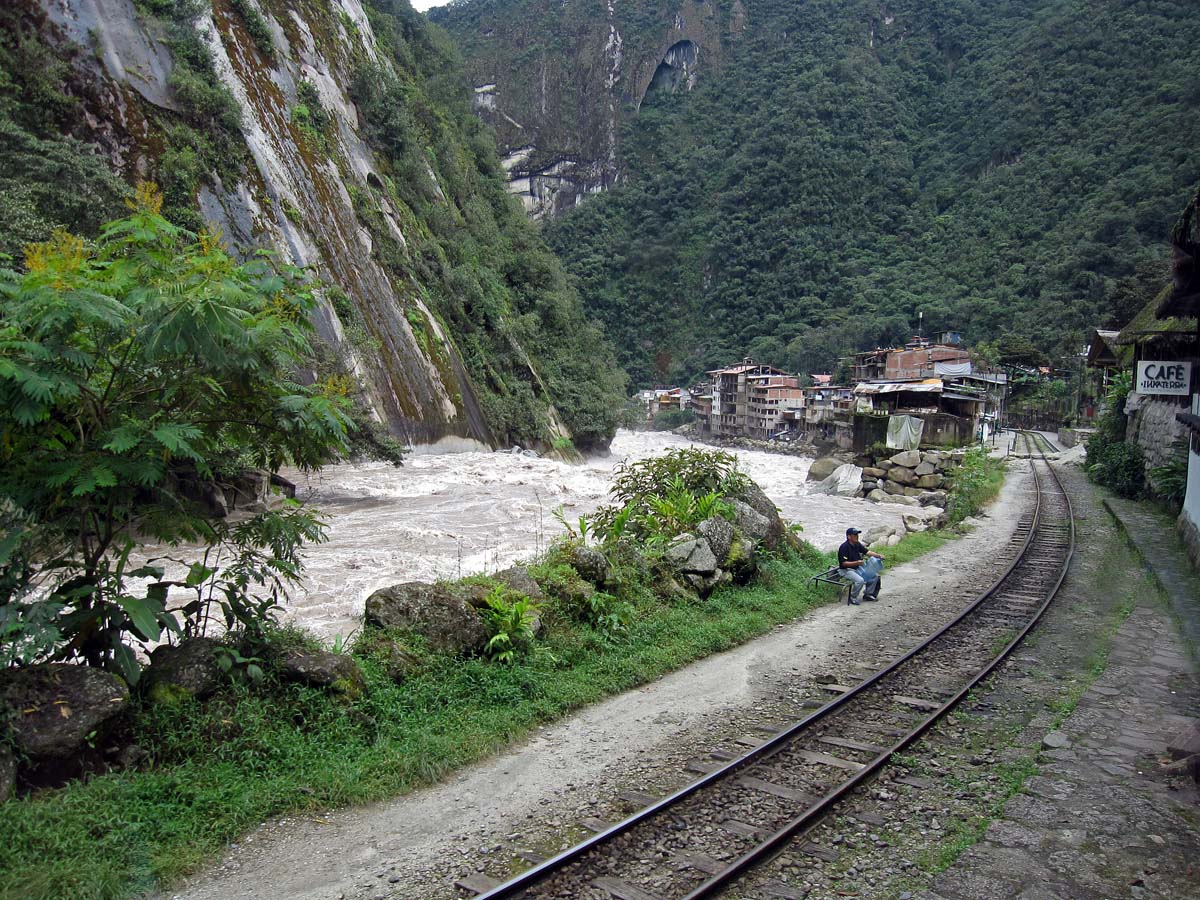
Located at the base of the mountain, Aguas  Calienetes is the
Located at the base of the mountain, Aguas Calientes is the “jumping off point” for visitors to Machu Picchu.

I rise before dawn and dress in the near dark. I grope the walls for the light switch above the sink basin. The bare bulb flickers awake and I quickly brush my teeth with bottled water. The bus is waiting.

The air outside is heavy and damp. Except for a handful of local outfitters and tourists who stumble towards the bus clutching coffee and backpacks, the outpost is still asleep. Seedy bars and overpriced restaurants sit idle and dark; souvenir stands cower under blankets of plastic. Wedged on a sliver of land between the roaring Urubamba River and the longest mountain range in the world, Aguas Calientes seems less like a town than a few forgotten crumbs lining the pocket of the giant Andes.

The movement of the bus jolts me awake. I am one week and three thousand miles from home in the jungle of Machu Picchu. My husband was so furious about my leaving that he barely spoke to me in the days leading up to my departure. He gave a lame excuse for not driving me to the airport to which I countered that since I could get myself to South America, I most assuredly could get myself to a plane. My departure was icy. Was it too much to ask him to understand that I was drawn to this place like water to a divining rod? There is risk in all travel but I was well-prepared for the trip. I was troubled and disappointed that after nearly thirty years of marriage, my husband and I were unable to simply agree to disagree.

After our plane landed in Lima, it took nearly a week to acclimate to the altitude and travel by bus and train to reach the jumping off point at the base of Machu Picchu, Aguas Calientes. We spent the afternoon exploring and hiking the ruins. The beauty was breath-taking. I snapped hundreds of photos but none captured the spiritual essence that draws over three millions visitors to this remote area of Peru.

Today’s outing, however, seems not so promising. The sky is a low grey ceiling; driblets of water trace the window glass. High above the main site, two massive stones mark the Inti Punku or Sun Gate. Researchers believe it to be the original main entry to Machu Picchu from the Inca Trail. On rare mornings when the mountain is not shrouded in cloud cover, the sun rises directly between them.

The bus drops us off near the gate and we begin winding ourselves up and around the side of the mountain. A few hikers turn back, uncomfortable with the narrowness of the trail. Alone and unafraid, I move steadily in silence, holding close to the mountainside. The clouds occasionally thin into wisps of cotton candy. I glimpse the sky; we have missed the sunrise.

At the summit, our guide Fernando sits perched like a spider across a boulder. He is mysteriously suspended in mid-air, supported by clouds. Lanky and handsome, he looks more Spanish than Kechuan. He has a surprising mouthful of silver braces and habitually lowers his head self-consciously. Chuckling to myself, I greet him by name. As a child of the ‘80’s, “Fernando” reminds me of the Abba song. I mentally hum a few bars but I can only recall the words to the chorus. I pull my water bottle and some nuts from my backpack and sit down beside him.

“You speak English very well” I say. His shy smile says he is pleased by my compliment. He tells me how he grew up about fifty miles away in the original Incan capitol of Cuzco. A few summers back, he travelled to New York. He loved the US and hopes to return when he has saved enough money.

At the mention of home, I feel myself tense.

Like a door that has been left open, I am suddenly aware of a hollow, nearly imperceptible hole in myself. I am chilled; the wind seems to blow right through me. Fernando thanks me, straightens his limbs and with a word of caution, disappears back down the trail. What had happened? Had Fernando sensed it too? Breathing in the vapors, I stare into the milky abyss, willing myself to remember this place, this moment.

I discover along my descent that the jungle has come alive in my absence. Slithering vines snake upwards while orchids languish like jewels on emerald silk, glistening from the previous night’s rain. Trills from tropical birds pierce the space high above my head and a glint of color flashes in my peripheral vision. I stop, peer up and then down the side of the mountain, yet see nothing but clouds. Further down the trail, the apparition reappears, hovering like an orb. Small and transparent as cellophane, its color shifts from yellow to pink to lavender. I try to photograph it but the camera lens moves in and out as if there is nothing there. I rub my eyes and look again, but it is gone.

Am I imagining things?

Suddenly, there is a break in the clouds. For a few moments, the magnificence of Machu Picchu spreads like a postcard below me. Mountains guard the site like moss covered sentries. Clouds swirl and dance, snagging themselves on distant peaks and wrestling the sunlight in a war of dark blue and purple. Stone walls and terraces lay cast upon the earth like a toddler’s forgotten puzzles. I am utterly spellbound.

I greet Fernando at the trail’s end and recount to him my experience. His face lights up as he explains “There are many butterflies in the Amazon called Morpho Butterflies. They seem to change colors when they fly!”

A week later I have returned back home. Like the maps and souvenir rocks and coins I brought home, my recollection of the mysterious butterfly becomes lost among the numerous memories of my journey. I sleep in my comfortable bed and drink fresh water, yet I am filled with discontent. Everything is moving too fast. On nights I cannot sleep, I walk into my backyard. I am transported back to my time in Peru. I gaze up to see the same sky that had held me pinned to those mountaintops. Now I feel weighted down by earth.

Years later, I begin searching for the creature I saw fluttering in and out of those clouds. While there are hundreds of species of butterflies in the Amazon, none seemed to look like the image I remembered. Only recently, I discovered what I believe I saw: The Mother of Pearl Morpho Butterfly. It is described as “the most iridescent of all butterflies.”

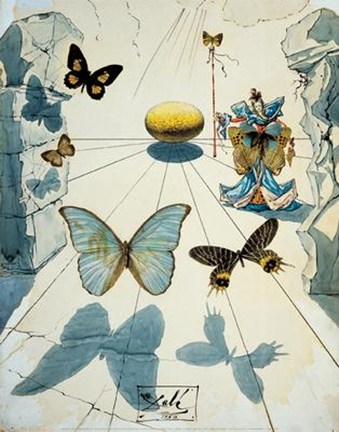
I was surprised to find this butterfly prominently featured in the Salvador Dali painting, Allegorie de Soie or Allegory of Silk. This work features disjointed images of an egg, a woman clad in elegant silk attire and several butterflies including the Pearl Morpho. The images are superimposed on a background whose shadows and lines give the feeling of time passing.  I interpret the piece as a  statement of transformation: the cocoon into the butterfly, the butterfly into the woman and then the woman back into the butterfly. Not shown, is the cracking of that egg, the unrest, the messy, chipping away of the old which is the untidy forebearer of all transformation.

“Change” is not particularly pretty nor is it easy.

Pearl Morpho Butterfly

It is disconcerting when we realize we are living a life that no longer fits. I believe it is human nature to want to keep that which we hold dear in those safe familiar places and yet, it is a manifestation of the spiritual and our trust in the divine that gives courage and leads us down unforged roads into unfamiliar territory. We are not born to be stagnant. It was in the unfamiliar that I began my own transformation. In middle age, I am attuned to the sound of my own heartbeat and in the listening, I become alive.

Salvador Dali's painting, Allegorie de Soie.
Salvador Dali’s painting, Allegorie de Soie.

Trouble

Aunt BJ is in trouble.

From the hallway, I almost don’t recognize her as I peer through the dim light, past the hum of equipment and maze of tubes connected to the woman asleep in the hospital bed of the ICU. I enter the room, slip my hand into hers. “Julia?” she whispers and flutters her eyes, mistaking me for a moment as her daughter-in-law. “No, it’s Susan.” A faint Mona Lisa smile. I go to kiss her cheek and am overcome by a lump in my throat; it escapes and re-emerges as fought-back tears. I was clearly not prepared for this and I feel bad for letting my emotion show. I am not here to bring her down. My aunt, who at age 79 and in the intensive care unit, doesn’t miss a thing.

In this awkward moment, I am rescued by the arrival of Mary, a young friend of Aunt BJ’s and  who is instantly my friend, too. We make brief introductions. Of course, we’ve heard of each other; Aunt BJ makes a point of bragging about all of us at one time or another. I am the author, the interior designer who helped with her house and works on hotels. Mary is the niece of her friend Myra, and served our country as a colonel in the military and has a young son. At the moment, Mary is more like an angel who has come into the room to offer, in addition to love and encouragement, chapstick and hand lotion, a swab of moisture on a stick. I sit there on my stool, still in my latent state of shock, holding that hand like it’s all that is holding me to this earth. It is soft and without tubes, with elegantly painted nails. I try hard to find a brave face, to not look on the outside like I feel on the inside.

It’s very difficult for Aunt BJ to speak so Mary and I talk while Aunt BJ closes her eyes and interjects when she is able. I tell Mary that Aunt BJ is the epitome of a Steel Magnolia while Mary declares she is a lady. We are both correct. On my way home, however, I ponder what does it mean to be a lady? I only know there are painfully few out there, myself included.

I know Aunt BJ became a lady and rose above difficult circumstances despite many challenges. She was born down the road from my family on Goat Pasture Road, the daughter of my mother’s older sister Aunt Polly. I have always called her my aunt although she is actually my first cousin. These last years since my own mom passed away, she’s been as much a mother to my sister Janie and I. She grew up poor, like most of my family, but things were especially hard when she was young in the years surrounding World War 2. Until her father built their pretty little wood clad house, the one I remember Aunt Polly and Uncle Glenn living in down the road from my family, her family lived in a horrible little shack right across from my grandmother a little further down the road. Aunt BJ told me once that she was mortified her classmates would discover where she lived. She remembers trying out for the basketball team in high school and seeing the back of her legs for what seemed to be the first time; she was filthy, embarrassed that on the farm, she had not been taught how to properly clean herself.

I cannot help but think how powerful these types of circumstances are to shaping us into our adult selves. If you had only known my aunt as a grown woman, you would never imagine her as that little girl. Known for her refinement, elegance and beauty, long blonde hair pulled up in a classic chignon, her warm and gracious home, always a place of love and laughter, its crystal chandelier hanging like a brilliant sun over a huge dining table filled with family, every chance she could get- you would never imagine her ever as that dirty young girl. She married my Uncle Charlie when she was just 16 and together they created a wonderful life and family. She became a highly successful businesswoman, out of sheer guts and determination, I imagine, because there has never been a road map how to get out of poverty. Aunt Betty Jo is kind and generous and wise and I would be so happy to sit at her feet and have her tell me stories every day for the rest of my life.

“I have many more things to tell you,” she whispered as I said my goodbyes yesterday before leaving her hospital room and I agreed. We will talk again soon. My aunt is never one to break her word and I know if it is possible to beat this thing, she will be the one to do it. As I was tracing my way back to my car in the parking garage, I paused to glance out the window of the breezeway, through an appropriate deluge of rain and out over the city of Winston-Salem. One of the businesses below had posted huge letters on top of their roof facing the hospital spelling out “G-E-T  W-E-L-L.” I surmise that should I return to this place, the letters may or may not be there, so personal did their message seem to express my wishes for my aunt that they could have been a mirage.

I know well enough that the best and hardest things in life are universal; it’s only in the details there is much difference. Life and death, the challenges of growing old, sickness, worries over our children and grand-children, the disappointment in ourselves and over the mistakes we’ve made and the doubts we feel when we wonder if we did the right thing. “Don’t be so hard on yourself. You just keep being Susan,” Aunt BJ had whispered to me before I left. I should have simply agreed with her, these were hard-earned breathes she was sharing with me but instead, I brushed it off, uncomfortable “I will, Aunt Betty Jo.” I said. “It’s the only thing I know how to be; I am me out of default.” I sensed a flash of her disapproval. I only hope we can have a talk about that later.

For Aunt Johnnie

Aunt Johnnie with my cousin Lisa at our family reunion in 2011.

One is fortunate if they can look back on their life and know of at least one person who only brought them joy and who loved them unconditionally. A person for whom it can be said that the lives they touched are infinitely better for their mere existence. Tonight, I lost one such precious soul and heaven gained a true angel in the passing of my Aunt Johnnie Young. She was a gentle soul, selfless, never aspiring to be the star but a gracious supporting player in my rowdy extended family on Goat Pasture Road. We celebrate with certain joy that she has joined her husband, my Uncle Frank Young and her son Bobby, both recently passed, as well as her own parents and much of our extended family who have gone before her.

It cannot be underestimated the power of love on a single life. We must remember one does not have to be a mother or the central figure in a person’s life to have a profound impact. Aunt Johnnie exemplified that for me in leaps and bounds. When my own parents had gone off their rocker, my mother in some mean, psychotic state or my father numb and oblivious to the dysfunction choking our family. When her own husband could be heard yelling and cussing a quarter-mile up the road, having what we all called a “Young Fit”. When the men of my family were off on some rampage with guns and hunting dogs trailing some would be burglar through the words in a true “posse.” When you felt lost or that you were very small and significant Aunt Johnnie was there with a hug and a smile and her steady reassurance. She personified “normal” for me, a tremendous gift in a family of eccentrics and larger than life personalities.

So loved was she by all, I don’t believe anyone in my entire family ever uttered an unkind word about her. Aunt Johnnie made the special times of my childhood even more so. She played the piano, as did I. From the time I was a little girl, remember many Christmases sitting with her on the bench at the old upright piano and playing and singing Christmas carols together. She was a fabulous Southern cook who always seemed to have something simmering on the stove when we dropped by. She made incredible Persimmon Pudding, the persimmons freshly picked from a decrepit old tree in the side yard that I imagine my grandmother must have planted decades before. Delicious cakes and rich pies. She spoiled us with her cooking.

All babies loved her. I remember her taking my own son Brennen into her arms when he was small and fussy and how she could soothe him with her calm demeanor. She loved to read my writing about the family and my adventures since our move to the city and I always sent her copies of anything that was published, especially since my own mother was gone.

Aunt Johnnie was a “healer” and was well-known in our family for skills of “talking” the itch out of poison oak and the fire out of burns. Numerous times, as a child, I would be afflicted with poison oak or ivy that I had caught playing in the woods and Aunt Johnnie would lay her hands on me gently, rubbing them so softly back and forth, whispering barely audible words that no one could understand. I found what she did fascinating. When I went to visit her last month the day after her son died, she was unable to discuss her loss and so we talked about other things. I asked her about her “healing” work. She was supposed to have passed the gift down, but never did. It had to be a man, she said, and I could only think how all the men in that part of the family were too busy hunting or working or fixing things they never wanted to learn such gentle skills. I asked her where her gift had come from, because it was not something in her younger years that she would talk about. She told me it came from the Bible, from the belief that through God a person’s hands could be used for healing. I thought about that tonight as I sat beside her holding those hands that have grown so much smaller than mine over these fifty years.

She’s been in a nursing care facility for a little over a year, but I was fortunate to visit her when she was in better health not long after my Uncle Frank died. My sister and I sat in her warm kitchen which was never especially clean or tidy, given the old wood stove that heated the house and her shy, shaggy dog “Booger” lumbering around behind the furniture shedding dog hair. It was sunny and cozy that cold afternoon but the kitchen was filled with warmth and light, even in the aftermath of her loss.

She was strong in a way different from the men of the family. She outlived her oldest, my cousin Bobby, by little more than a month. How difficult it must have been to go on, for these few years and this past month, after losing two of the most important people in her life, but she did, with the same poise and grace that exemplified her entire life. Thank God for special aunts, for special people, for loving souls and gentle spirits. Thank God for my Aunt Johnnie! We celebrate her transition to another life and know she will continue to watch over us. We love you and we will miss you.

Love, Tootie

Incarcerated

jail

It’s a matter of public record that my brother has been in and out  jail recently on numerous offenses. Beyond the occasional speeding ticket, my brother’s run-ins with the law and his subsequent incarcerations are a first for our mostly law-abiding family.

It’s a few hours drive for me to visit him in the small county jail where he is locked up. Beyond the drab municipal buildings and razor wire fencing surrounding the courthouse, it’s a sad depraved little town whose people seem to have not enough to do and not enough resources to do it with.

Jail visits are surreal for those of us not behind the bars. It’s difficult to know what to say or do. The thoughts that pass through my mind do not seem so appropriate or helpful. I wonder what does one wear in order to look like the little sister of a man who would not break the law? I have never been a fashionista, but it seems important for me to make a good impression, like I am a reflection of my brother’s guilt or innocence. I thumb through my assortment of formless sweaters, omitting the black and white striped one for the obvious reason. I gravitate instead towards neutrals, colorless putty tones that will not show soil or make me stand out too much as a visitor. A scarf adds some cheer and hides my ample bosom from lewd gazes. Then, my mind shifts from my wardrobe to that old familiar comfort of food. Shouldn’t I bake a cake for the occasion? Folks always did that on the old television shows, right? I think how I would not hide  a weapon inside, honest I wouldn’t. I just think it would be so very nice to take him a cake and share it with the guards. Maybe that would earn him some television time or a walk outside for fresh air.

I ride down with my nephews, my brother’s grown children. We all lead busy lives with family and work in our places of too much to do and not enough time to do it in. I enjoy catching up on their lives. We stop to eat, of course, either lunch or breakfast at a local diner or barbecue restaurant. My nephew says “Aunt Susie, this would be fun if we didn’t have to …” His voice trails. He doesn’t have to finish the sentence; I know what he means.

I am angry at my brother, angry at his choices and actions. At times I can barely contain it; at times I do not. There is a feeling that like a contagious disease, he has brought an undesirable element to our lives. I want it to go away. I do not want our family poisoned.

At the jail, my nephews and I huddle around one of three small windows just off the lobby, attempting to talk to my brother via a menacing telephone that appears left over from the 1960’s. I regret not bringing antiseptic wipes, but my mind was on other senseless matters like the outfit and the cake. The telephone line is filled with static. My brother somehow sounds miles away instead of two feet behind the glass. What cannot be heard or spoken in words is evident in the setting of the jaw, the cold dullness of blue eyes, everyone’s aching to get out of there.

Later, I make small talk with the guards.  Some of the female guards remind me of that old character “Pat” on Saturday Night Live; I am left questioning much about their sexuality. They laugh good-naturedly about my brother, who can be humorous and quite charming when he is not armed or drunk. These are traits I share with most everyone in my family, the humor and charm, that is, not the drunkenness, although many folks back home are armed to the hilt. I finally succeed in endearing the guards to please pass my brother a pair of my old reading glasses and a pen with which he can read and write. Along with a few dollars in his canteen, it is all I can offer, this weak but real connection to the outside world.

I miss the brother that I knew, my brother who is all but lost from his family and is now starring in a tragi-comedy of his own doing. His role is both antagonist and victim. The numerous charges against him include assault, making threats, discharging a firearm in the city limits, however the real crime is a life gone missing outside this jail cell.

My brother has always been a fighter but rarely, until his old age, did it get him in serious trouble. One of my earliest memories of my brother is when I was three or four and I insisted on staying up past nine o’clock to watch the I Love Lucy Show. Daddy would put me in bed and I would immediately crawl out. When my patient father finally threatened to give me a spanking, my older brother met him in the hall, one fist repeatedly slamming into the other. “Don’t hit her daddy. Don’t hit her, ” he said. I still remember him saying that. I never did get a spanking that night  although I probably should have. I hold fast to this memory of my protective older brother. I would like to return the favor now but I cannot and he will not listen. There is little I or anyone can do to protect him now against himself.

It occurs to me that whereas my brother is a fighter, I am a flyer. Over the years, this behavior has imprinted itself on me as sense of  worthlessness, of being a secret self-loather, a weakling unable to take charge of her own destiny. A woman whose very wonderful and blessed life can feel as sparse and distant as breadcrumbs dropped on a path through the woods. Most days I know the crumbs are simply the negatives of life that for years I swallowed and swallowed and swallowed. These things sit and ferment in ones stomach, then eat you from the inside out. The truth is I fear loosening the lid on my own Pandora’s box. I fear what might emerge. I fear it could be the madness and rage that has taken over my brother. I realize then that beyond charm and the same color blue eyes, I share something else with my brother. I too am both antagonist and victim in my own life. There are many crimes I commit, but what gnaws on me most is the same, that of leading a life of unrealized potential.

It is the hardest thing in the world to do, isn’t it? To free ourselves from whatever it is that imprisons us. It is so difficult to walk away from behaviors that are self-destructive and no longer serve us well, even when we know we should. We are all incarcerated, each in our own little cell, searching for a means of escape.

Blog at WordPress.com.

Up ↑